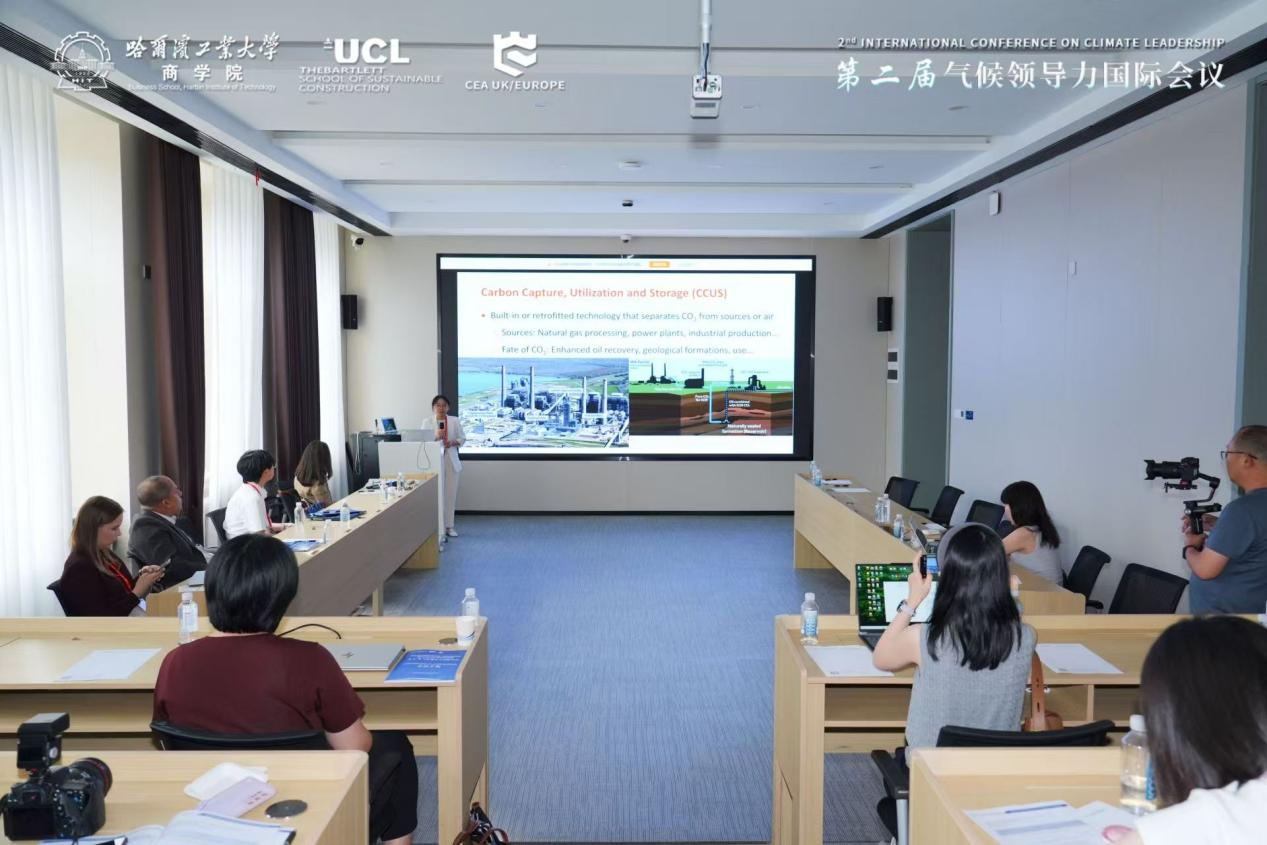
The Second International Conference on Climate Leadership was recently held at Harbin Institute of Technology. The parallel forum on "Energy Transition and Low-Carbon Technology Innovation" convened in two sessions, covering the low-carbon transition of energy systems, digital technology enablement, corporate climate governance, and green innovation. More than 20 experts and scholars from China and overseas participated.
Energy System Transition and the Global Governance Landscape
The forum opened with macro-level trends in energy system transition and the global governance landscape. In international shipping, a retrospective analysis of China's maritime carbon emissions and net-zero pathway found that emission responsibility spans flag states, port states, and cargo-owning states, arguing for greater use of embodied-emission or consumption-based allocation methods. Single efficiency, fuel, or pricing instruments cannot close the emissions gap; a policy mix accounting for carbon, pollution, and health costs is needed. On the relationship between oil supply and green finance, the capital cost premium has a nonlinear effect on emission reductions in high-carbon industries: a modest premium may prompt producers to accelerate extraction, fostering short-termism; financial exit policies should therefore be coordinated with carbon pricing and other instruments.
On equity and pathway diversity in global energy transition, the Energy Transition Readiness Index identifies potential winners and losers across traditional risk, transition assets, human capital, and institutional capacity. Although Global South countries hold substantial renewable energy potential, they are constrained by economic and institutional capacity; existing international mechanisms struggle to ensure a fair distribution of costs and benefits, necessitating differentiated targets and financial and technical support. An analysis of transition-condition combinations under the Paris Agreement found that no single necessary condition guarantees success—formal commitments do not automatically translate into domestic action; structural advantages, market incentives, closed-loop commitment and policy frameworks, breaking fossil lock-in, and mature governance can each be effective in different configurations. Policies should shift from replicating isolated tools to identifying country-specific contexts, using complementary portfolios to bridge the commitment–action gap. In negative emission technologies, failure is not purely a negative signal: when reduction pathways are uncertain or technologies immature, it can spur further innovation, while successful deployment tends to validate existing technologies, shifting knowledge accumulation from codifiable patents to hard-to-quantify practical experience.

Digital Technologies Enabling Green Transformation
The deep integration of digital technologies with low-carbon transition was a central theme. At the firm level, business–finance integration alone does not significantly reduce climate risk; only when combined with Artificial Intelligence capabilities can firms strengthen forward-looking governance through improved information processing, forecasting, and collaborative decision-making—an effect particularly pronounced for transition risk mitigation. Digital governance capability is the key to converting informational advantage into climate resilience. Digital innovation not only directly improves Environmental, Social, and Governance performance but also enhances risk buffering through greater organizational slack, and exerts positive effects by reducing supplier concentration and optimizing external resource dependence; digital investment should therefore advance in tandem with organizational resilience and supply chain diversification.
At the regional and industrial levels, Artificial Intelligence improves resource allocation efficiency, increases Research and Development investment, optimizes human capital structure, alleviates resource lock-in, and fosters corporate innovation—with a particularly strong role in driving breakthrough innovation. Digitalization reduces cities' resource dependence, though cities at different lifecycle stages have varying absorptive capacity; data factor markets and innovation ecosystems should be built with city-specific policies. The establishment of National Pilot Zones for Next-Generation Artificial Intelligence Innovation significantly improved regional carbon emission efficiency, with stronger effects in non-mountainous and manufacturing-dominated regions; the pattern reflects an asymmetric mechanism of spatial spillover and "followers learning from leaders," underscoring the need for stronger cross-regional knowledge diffusion and collaboration. In energy market volatility, media climate sentiment acts as an information channel shaping expectations in low-risk periods but shifts to a risk reflector in high-risk periods; its long-term spillover effects exceed short-term ones, indicating that media narratives are more closely tied to persistent policy and market expectations.

Low-Carbon Technological Innovation and Industrial Practice
The third theme focused on low-carbon technology innovation pathways and policy instruments. An analysis of building decarbonization vulnerability found that decarbonization difficulty depends not only on technical attributes such as building age and energy efficiency but also on social factors including health deprivation, retrofit costs, and educational attainment, with a clear threshold effect. Decarbonization policies should therefore shift from single technological retrofitting to socio-technical coordination, enhancing vulnerable groups' capacity to participate in and bear transition costs. Clean production innovation diffusion at the industrial park level manifests as cross-layer interactions among production, knowledge, and policy networks, where leading firms can trigger cascading diffusion; targeted combined interventions at key nodes are faster and broader than uniform subsidies, and parks should be treated as interconnected systems for precise resource allocation. Externality management in the direct air capture industry includes converting positive externalities into tradable products, exchanging carbon credits through standardization and market aggregation, and extending trading cycles via long-term contracts; emerging industry development depends not only on technological breakthroughs but also on public rules, market intermediaries, and corporate strategies jointly reducing uncertainty.
On cross-sectoral coordinated emission reduction, air pollution control policies significantly reduced sulfur dioxide and carbon dioxide emissions, with coordinated reductions coming mainly from industrial production; pollution abatement and carbon reduction targets should be integrated, with emphasis on targeted industrial source governance. Power-sector technological innovation and green development show a positive spatial correlation with regional variation, and can also indirectly promote green high-quality development by raising agricultural productivity and accelerating industrial capital accumulation. The impact of population aging on green productivity is significantly nonlinear, with education, industrial structure, and corporate automation investment altering its direction and magnitude. Additionally, studies on interprovincial energy resilience networks, the synergistic climate benefits of Glucagon-Like Peptide-1 receptor agonists, and the political economy of climate-adaptive water governance offered new perspectives for cross-sectoral collaboration.

The two-day forum spanned international shipping, oil supply, negative emission technologies, industrial parks, Artificial Intelligence, corporate Environmental, Social, and Governance practices, and regional energy resilience, highlighting the systematic and interdisciplinary nature of energy transition. Research shows that low-carbon transition cannot rely on a single technology or policy: digital technologies must be integrated with organizational governance, green finance must work in tandem with carbon pricing, and regional policies must fully reflect differences in development stage, resource endowment, and institutional capacity. The multidimensional evidence and policy recommendations provide valuable reference for improving the low-carbon technology innovation ecosystem, enhancing climate resilience, and advancing a more equitable and effective energy transition. Harbin Institute of Technology Business School said it will continue to promote academic exchange and practical exploration in energy transition and low-carbon technologies, contributing to green and low-carbon development.


