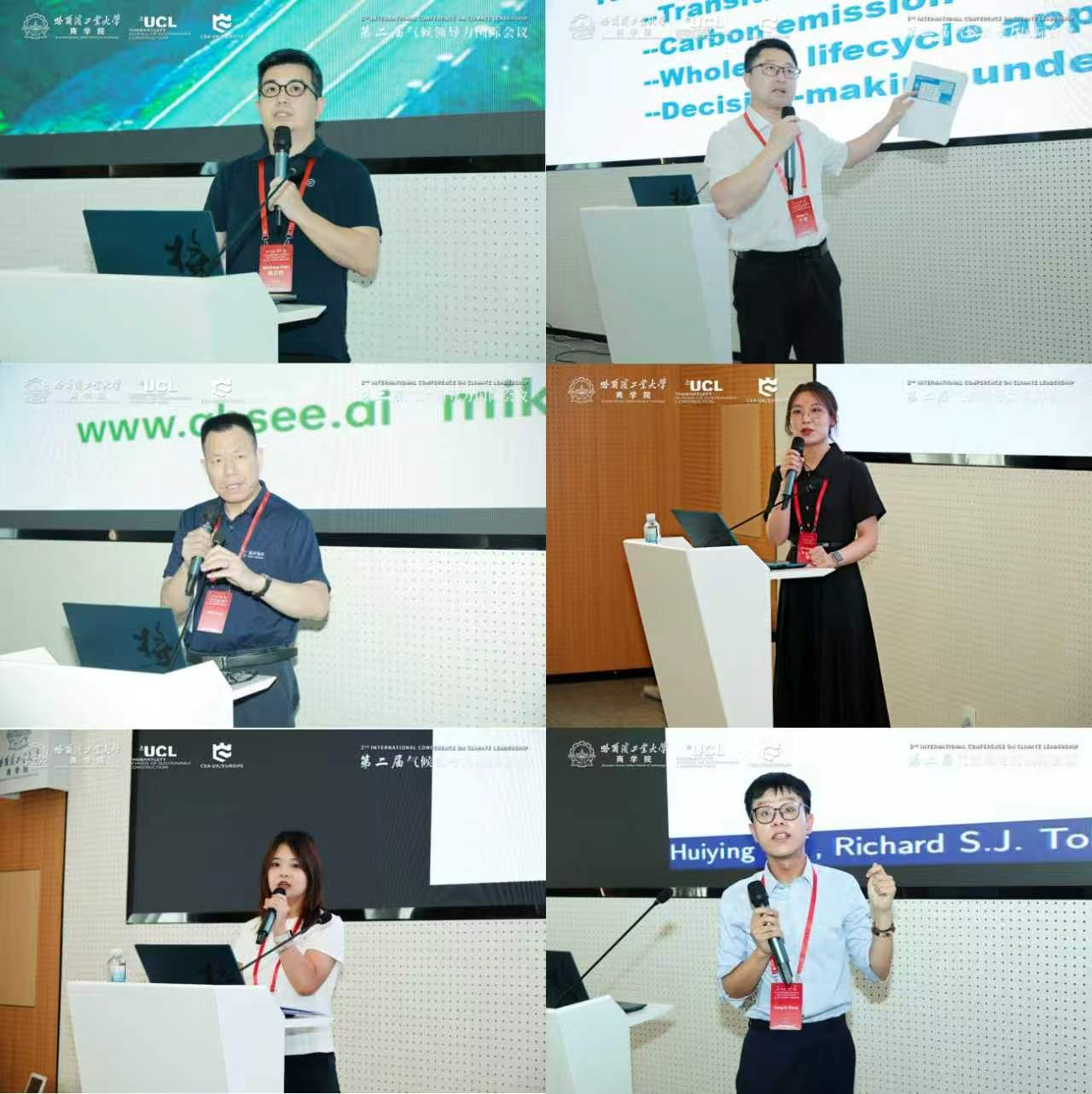
The Second International Conference on Climate Leadership was held at Harbin Institute of Technology Business School from July 18 to 20, 2026. A parallel forum on "Corporate Green Transformation and Digital-Intelligent Efficiency Enhancement" convened on the afternoons of July 18 and 19 as a key component of the conference. The forum brought together 21 experts, scholars, industry leaders, and early-career researchers from SF Express Group, the New Zealand Institution of Engineering, and universities in China and overseas. Discussions centered on how digital and intelligent technologies can advance low-carbon transformation, industrial restructuring under carbon constraints, and climate risk governance in global supply chains—offering fresh perspectives for achieving China's "Dual Carbon" goals and driving sustainable corporate transition.

Technology-Driven: Digital Intelligence Powers Green Efficiency Gains
The forum's opening session focused on technology applications. Chen Naichong, a digital-intelligent supply chain solutions expert at SF Express Group and the only logistics enterprise representative invited to speak, outlined how Artificial Intelligence and digital-intelligent technologies are being deployed in supply chain operations. He explained that SF's proprietary "Fenghe Carbon Management Platform" automates carbon accounting across millions of waybills, demonstrating that sophisticated algorithmic optimization can boost efficiency while organically cutting emissions—turning the vision of "structural efficiency gains and cost reduction, compounded by carbon-related benefits" into reality. Yu Gang, a Fellow of the New Zealand Institution of Engineering, emphasized from an infrastructure perspective that transportation systems need full-lifecycle asset management and dynamic adaptation pathways, using quantified carbon footprints to advance low-carbon transition.
Scholars also debated the relationship between Artificial Intelligence and carbon emissions. One proposal combined drones with infrared sensing for intelligent building inspections, a solution that could improve energy efficiency while reducing risk. On the regionally uneven impact of Artificial Intelligence on emissions and the need for differentiated carbon regulation across supply chains, experts stressed that Artificial Intelligence investment must be balanced against climate objectives so that technological gains are not erased by higher energy use. Research suggests that Artificial Intelligence investment may overall increase emissions, though this does not change the direction of climate policy; going forward, a dynamic balance between Artificial Intelligence and climate investment will be critical.
Carbon Mechanisms and Policy: Reshaping Markets and Supply Chains
On carbon pricing and trade policy, experts highlighted the complex effects of mechanism design. Research on the Carbon Border Adjustment Mechanism, based on global modeling, found that its overall employment impact is limited but sharply uneven, with low-skilled workers in developing countries bearing the brunt. Other studies noted that the Carbon Border Adjustment Mechanism's default-value methodology may overstate the carbon responsibility of countries with long supply chains, urging greater transparency in emissions accounting.
On new energy vehicles and carbon leakage, one study examined inter-city emissions transfer in China's New Energy Vehicle rollout and found that lower-income cities shoulder a disproportionate share of transferred emissions, recommending faster power-sector transition and compensation mechanisms. From a capital market angle, scholars confirmed that financing policies ease corporate funding constraints during transition, while climate risk pricing improves the maturity matching of corporate investment and financing through market discipline.
Experts also built a global supply chain optimization model for the steel industry, offering a new analytical framework for decarbonizing high-carbon sectors. They stressed that trade and climate policies must work in tandem to prevent emissions imbalances triggered by supply chain restructuring.

Risk Governance and Just Transition: Building Global Climate Resilience
The forum's second half focused on risk propagation and inclusive development. Studies showed that climate disasters can spill over across borders through trade networks, causing economic losses elsewhere; researchers recommend diversifying trade partners to build adaptive capacity. A host country's climate governance capacity significantly affects multinational firms' investment decisions, and corporate adaptation strategies are reshaping the global environmental governance landscape. On supply chain governance, key customers can use exit threats to monitor suppliers' Environmental, Social, and Governance performance and reduce supply chain risk.
On just transition, scholars analyzed how China's poverty alleviation policies affect emissions, finding that less developed regions bear higher climate costs and need greater regional sharing of green technology. The Arctic shipping route's potential to reshape rare earth trade patterns also drew attention, as it could strengthen the resilience of critical mineral supply chains. The differential effects of product and capital market pressures on green innovation in digital trade emerged as another hot topic.
On investment and governance mechanisms, experts drew on case studies of leading international institutional investors to show how shareholder engagement can improve corporate governance. They also examined the conditions under which blended finance can catalyze private capital, with all speakers underscoring the critical role of multi-stakeholder collaboration in climate governance.

The forum offered a comprehensive overview of cutting-edge research at the intersection of corporate green transition and digital intelligence. Participants agreed that technological innovation, policy design, and risk governance must be deeply integrated, with urgent breakthroughs needed in Artificial Intelligence enablement, fair carbon accounting, and global supply chain resilience. The findings provide a valuable reference for government, industry, and academia to advance the integration of digital-intelligent technologies with low-carbon development, while also contributing Chinese perspectives to global climate governance. Harbin Institute of Technology Business School said it will continue to build high-level exchange platforms to help enterprises move toward a sustainable future.


